
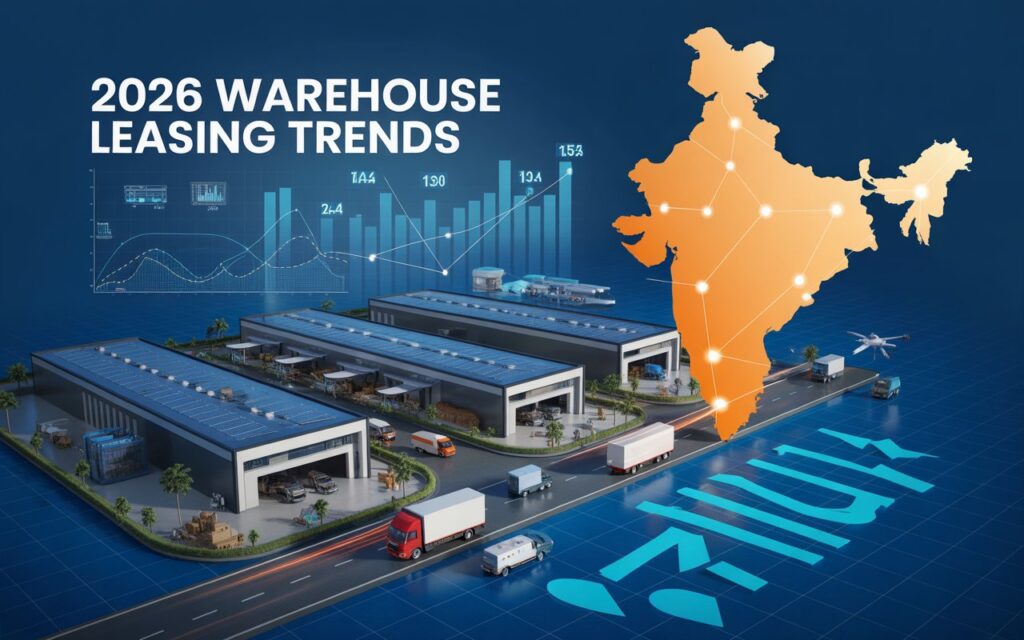
India’s warehouse leasing market in 2026 is experiencing rapid transformation driven by e-commerce growth, technology adoption, and infrastructure improvements. Key trends include increased demand for Grade-A warehouses, growth of Built-to-Suit (BTS) facilities, expansion into Tier-2 and Tier-3 cities, adoption of smart warehousing technologies, and rising focus on sustainability and ESG compliance
The Indian warehousing sector has evolved from basic storage facilities to sophisticated, multifunctional logistics hubs. At Wadi Group, we help businesses navigate these shifts with expert insights and tailored real estate solutions that align with operational goals and market dynamics. This comprehensive guide explores the 13 most important warehouse leasing trends every business should understand in 2025.
Key Trends Covered in This Guide
This article covers 13 critical warehouse leasing trends, from evolving warehouse functions to sustainability requirements, helping logistics providers, retailers, manufacturers, and third-party operators make informed decisions.
1. What Functions Do Modern Warehouses Serve Beyond Storage?
Modern warehouses are multifunctional distribution hubs, not just storage spaces.
Today’s warehouses serve multiple strategic purposes:
- Cross-docking and consolidation operations for faster goods movement
- Value-added services including kitting, packaging, and returns processing
- E-commerce fulfillment centers and last-mile delivery hubs
- Cold chain and temperature-controlled logistics for pharma and perishables
- Omni-channel distribution centers supporting multiple sales channels
This functional evolution increases the complexity and strategic importance of warehouse leasing decisions, requiring businesses to evaluate facilities based on operational capabilities rather than square footage alone.
2. How Is E-Commerce Growth Driving Warehouse Demand in India?
E-commerce expansion is the primary driver of warehouse leasing demand in India.
India’s e-commerce market ranks among the fastest-growing globally, creating robust demand for strategically located warehouse space. Key drivers include:
- Rapid increase in online shopping penetration across urban and rural markets
- Rising customer expectations for same-day and next-day delivery
- Expansion of quick commerce (Q-commerce) for groceries, medicines, and essentials
- Growth of omni-channel retail requiring integrated inventory management
E-commerce companies prioritize warehouses near major consumption hubs like Delhi NCR, Mumbai, Bengaluru, and Hyderabad to minimize delivery times and reduce logistics costs. Proximity to urban centers has become a critical leasing criterion.
Know More:- Warehouse for Lease in India: Grade-A, RTM, and BTS Industrial Spaces
3. What Are Built-to-Suit (BTS) Warehouses and Why Are They Growing?
Built-to-Suit warehouses allow businesses to customize facilities according to specific operational requirements.
Many businesses are shifting from speculative warehouse leasing to Built-to-Suit (BTS) models because BTS solutions enable companies to:
- Design warehouses customized to operational requirements and workflow
- Control critical specifications like layout, ceiling heights, racking systems, and automation infrastructure
- Secure long-term leases with structured scalability options
- Implement specialized features like cold chain logistics or automated sorting systems
Companies with specific operational needs increasingly prefer BTS warehouses over ready-built spaces, particularly in cold chain logistics and automated distribution operations.
4. Which Locations Are Most Strategic for Warehouse Leasing in India?
Location remains the most critical factor in warehouse leasing decisions.
Demand has created strategic warehouse hubs across India offering excellent connectivity:
| Region | Key Warehouse Corridors |
| North India | NCR (Gurgaon–Manesar–Bawal corridor) |
| West India | Western Maharashtra (Pimpri-Chinchwad), Pune industrial belt, Ahmedabad–Vadodara axis |
| South India | Bengaluru–Hosur region, Hyderabad logistics clusters, Chennai–Kanchipuram corridor |
These locations benefit from excellent road, rail, and airport connectivity, directly influencing distribution efficiency and operational cost savings.
Read More:- Top Tier 2 Cities in India for Real Estate Investment in 2025
5. What Are Logistics Parks and Why Are They Gaining Popularity?
Large-scale logistics parks and integrated industrial hubs are replacing standalone warehouse facilities.
These modern logistics precincts typically offer:
- Shared utilities, security infrastructure, and facility management
- Multimodal connectivity with proximity to highways, expressways, and rail
- Plug-and-play ready facilities with pre-installed infrastructure
- Clustering benefits and operational synergies with adjacent tenants
Investors and businesses prefer these integrated ecosystems for operational efficiency, scalability benefits, and reduced capital expenditure on individual infrastructure components.
6. How Is Technology Transforming Warehouse Operations and Leasing?
Technological innovation is reshaping warehouse functionality and leasing criteria.
Key technological trends in smart warehousing include:
- Warehouse Management Systems (WMS) for real-time inventory control
- Robotics and automation for picking, packing, and sorting operations
- IoT sensor networks for tracking goods movement and environmental conditions
- AI-based demand forecasting and predictive analytics
- Digital twin technology for warehouse layout optimization
Companies increasingly seek warehouse spaces that support automation retrofits or technology upgrades, directly affecting leasing criteria and long-term investment planning. Industry reports indicate that businesses adopting these technologies achieve efficiency gains of 15-25%.
7. Why Is Cold Chain Warehousing Demand Increasing in India?
Cold chain and temperature-controlled warehousing is experiencing surge in demand.
The pharmaceutical, food and beverage, and perishable goods segments are driving cold storage demand because of:
- Regulatory compliance requirements for pharmaceutical storage and distribution
- Food safety standards and quality control for fresh produce and processed foods
- Specialty logistics for vaccines, biologics, and sensitive healthcare supplies
- Growth of online grocery and fresh food delivery services
Cold storage facilities require specialized infrastructure, higher capital investment, and operational expertise, significantly impacting leasing terms, rental rates, and tenant requirements.
8. Are Flexible and Short-Term Warehouse Leases Becoming More Common?
Yes, flexible and short-term warehouse leasing options are increasing alongside traditional long-term leases.
While long-term leases of 5-10 years remain standard for large-scale operations, short-term and flexible leasing arrangements are gaining traction among:
- Startups and growing businesses testing new markets
- Companies managing seasonal inventory fluctuations
- Third-party logistics (3PL) operators expanding capacity temporarily
- Businesses exploring omni-channel distribution strategies
Flexible leasing reduces financial risk and enables companies to adjust their warehouse footprint based on demand cycles, market conditions, and business growth trajectories
9. How Important Is Sustainability in Warehouse Leasing Decisions?
Environmental, Social, and Governance (ESG) considerations are increasingly shaping warehouse leasing decisions.
Sustainable warehouse features gaining importance include:
- Solar panel installations and renewable energy integration
- Rainwater harvesting and water recycling systems
- Energy-efficient LED lighting and HVAC systems
- Green building certifications (LEED, IGBC, GRIHA)
Companies with corporate sustainability goals increasingly prioritize eco-friendly warehouse spaces. Green warehousing can reduce operational costs by 10-15% through energy savings while improving brand value and investor perception.
10. How Do Government Policies Impact Warehouse Leasing in India?
Government infrastructure initiatives are significantly reshaping warehousing landscapes.
Key policy developments influencing warehouse leasing include:
- PM Gati Shakti National Master Plan for multimodal connectivity
- Development of industrial corridors and dedicated freight corridors
- Expressway expansion improving regional connectivity
- GST implementation streamlining interstate goods movement
Enhanced infrastructure translates to faster goods movement, lower logistics costs, and increased attractiveness of warehouse locations in both Tier-1 and Tier-2 markets. Logistics costs for compliant businesses have dropped by an estimated 10-12%.
11. Why Do Businesses Need Expert Advisory for Warehouse Leasing?
Professional real estate advisory services are critical for navigating complex warehouse leasing decisions.
With evolving market trends and technical requirements, businesses increasingly rely on experts like Wadi Group to:
- Identify optimal warehouse locations based on distribution networks
- Negotiate favorable lease terms, rental rates, and escalation clauses
- Conduct comprehensive due diligence on infrastructure and compliance
- Ensure regulatory compliance with building codes and safety norms
- Structure lease agreements with appropriate exit strategies
Tenant representation and market intelligence significantly impact leasing outcomes, cost savings, and return on investment throughout the lease lifecycle
12. How Is Supply Chain Resilience Affecting Warehouse Strategies?
Post-pandemic supply chains emphasize redundancy, agility, and resilience over cost optimization alone.
Companies are rethinking warehouse footprints to:
- Create strategic buffer stocks for business continuity
- Enable multi-node distribution networks across regions
- Reduce dependency on single large centralized facilities
- Build geographic diversification into logistics networks
This resilience-focused approach affects leasing strategies, pushing businesses to either expand warehouse portfolios, relocate facilities, or diversify across multiple markets and geographies.
13. What Lease Structure Elements Should Businesses Consider?
Modern warehouse leases involve complex financial and operational terms beyond basic rent.
Critical lease structure components include:
- Base rent with annual escalation clauses (typically 5-15%)
- Common Area Maintenance (CAM) charges and utility allocations
- Lock-in periods and rent-free incentive negotiations
- Tax responsibilities and service charge structures
- Renewal options and exit clause mechanisms
Understanding these financial components and negotiating favorable terms requires market expertise and legal knowledge to optimize total occupancy costs over the lease term.
What Should Businesses Do in 2026?
To succeed in India’s evolving warehouse leasing market, businesses should:
- Prioritize strategic location selection based on distribution network requirements
- Evaluate Built-to-Suit options for specialized operational needs
- Consider Tier-2 and Tier-3 cities for cost-effective expansion
- Invest in technology-ready facilities supporting automation
- Incorporate sustainability criteria into leasing decisions
- Engage professional advisory services for market intelligence
At Wadi Group, we specialize in delivering Grade-A warehouses and industrial spaces across India. Whether you’re expanding in metros or emerging regions, our expert team provides comprehensive tenant representation, site selection, and lease negotiation services to help you make informed warehouse leasing decisions.
Industrial Plots Kharkhoda: The Future of Manufacturing & Logistics Investment
Frequently Asked Questions About Warehouse Leasing in India
What is the average warehouse rental rate in India in 2026?
Warehouse rental rates vary by location and quality. In prime locations like Delhi NCR, Mumbai, and Bengaluru, Grade-A warehouse rentals typically range from ₹25-45 per square foot per month, while Tier-2 cities offer rates between ₹15-30 per square foot per month. Rates also depend on factors like infrastructure quality, connectivity, and lease terms.
What is the typical lease duration for warehouse space in India?
Standard warehouse leases in India typically range from 3 to 9 years, with 5-6 year terms being most common. Large-scale operations and Built-to-Suit facilities often involve longer lease commitments of 9-15 years, while flexible short-term leases of 1-3 years are increasingly available for specific business needs.
What are the main differences between Grade-A and Grade-B warehouses?
Grade-A warehouses feature modern construction with high clear heights (30+ feet), strong floor load capacity (4-5 tons per square meter), advanced fire safety systems, adequate loading docks, and compliance with international standards. Grade-B warehouses typically have lower specifications, basic infrastructure, and may lack modern amenities. Grade-A facilities command higher rents but offer better operational efficiency.
Which Indian cities offer the best warehouse leasing opportunities in 2025?
Top warehouse leasing destinations include Delhi NCR (Gurgaon-Manesar corridor), Mumbai-Pune belt, Bengaluru-Hosur region, Chennai-Kanchipuram area, and Hyderabad logistics clusters. Emerging markets include Ahmedabad, Coimbatore, Indore, Nagpur, and Vizag, which offer lower costs with improving connectivity.
How much upfront investment is required for warehouse leasing?
Typical upfront costs include security deposit (equivalent to 3-6 months’ rent), advance rent (1-3 months), stamp duty and registration charges (2-8% of total lease value depending on state), legal fees, and initial infrastructure setup costs. Businesses should budget for 6-12 months of rent as initial investment.
What infrastructure should I verify before leasing a warehouse?
Critical infrastructure includes adequate power supply and backup, proper drainage systems, sufficient loading docks and truck parking, appropriate floor load capacity, fire safety equipment and NOC, security systems, road connectivity, clear height specifications, and proper ventilation. Professional site inspections are essential before finalizing any lease.
Need Expert Warehouse Leasing Assistance?
Contact Wadi Group today for comprehensive warehouse leasing solutions tailored to your business requirements. Our expert advisory services help you identify optimal locations, negotiate favorable terms, and secure Grade-A industrial spaces across India.