
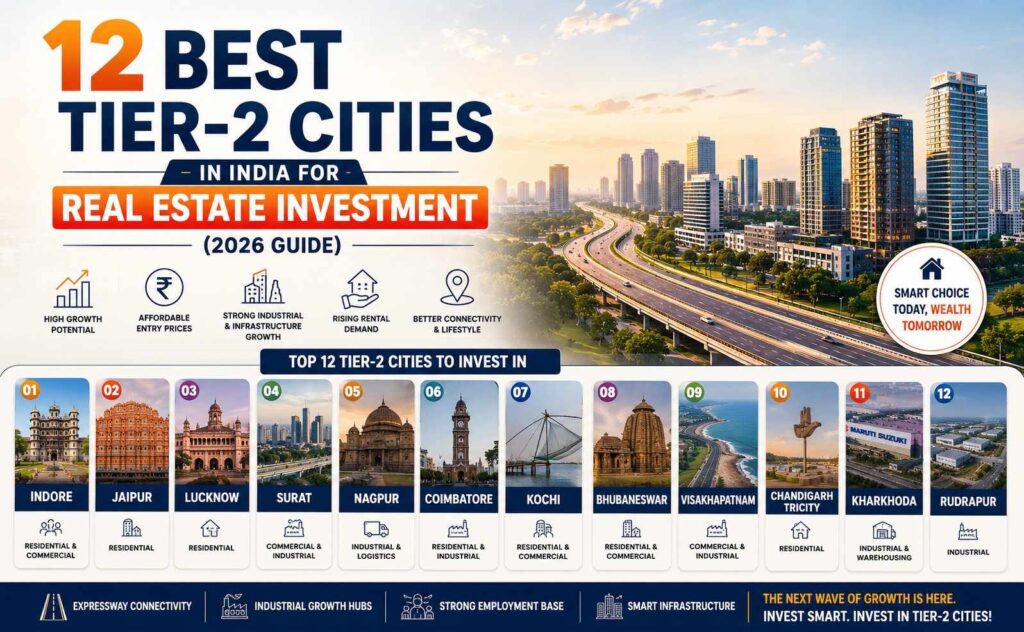
The best Tier-2 cities in India for real estate investment in 2026 are Indore, Jaipur, Lucknow, Surat, Nagpur, Coimbatore, Kochi, Bhubaneswar, Visakhapatnam, Chandigarh Tricity, Kharkhoda, and Rudrapur.
These cities are attracting capital because of expanding expressway and metro networks, growing industrial and manufacturing corridors, Smart Cities Mission investments, and rental demand from IT, logistics, and manufacturing employment hubs — all at a fraction of metro-city entry prices.
Among them, Kharkhoda in the Delhi-NCR industrial belt stands out for industrial and warehousing investors because of the Maruti Suzuki manufacturing complex and its direct connectivity to the KMP Expressway.
Why Are Tier-2 Cities Becoming Investment Hotspots?
For the last decade, real estate investment conversations in India revolved almost entirely around Mumbai, Delhi-NCR, Bengaluru, and Pune. That is changing fast. Metro cities have become expensive, congested, and increasingly difficult to develop in, pushing both residential buyers and industrial investors to look at Tier-2 cities for better entry prices and stronger long-term upside.
Several forces are driving this shift heading into 2026:
Rental demand is rising as industries, colleges, and hospitals create new local employment.
Government infrastructure spending on expressways, dedicated freight corridors, and airport expansions is opening up new investment corridors outside the metros.
Industrial corridors such as the Delhi-Mumbai Industrial Corridor and various state-level industrial model townships are pulling manufacturing investment into smaller cities.
Smart Cities Mission projects have improved civic infrastructure, water supply, and digital connectivity in dozens of Tier-2 towns.
Manufacturing and EV expansion is decentralizing India’s industrial base away from traditional hubs like Gurugram and Chennai.
Warehousing and logistics demand, fuelled by e-commerce growth, needs land close to expressways — land that is far cheaper in Tier-2 markets.
Affordability remains the single biggest draw: property prices in most Tier-2 cities are 40-70% lower than comparable metro locations.
For investors, this means Tier-2 cities today offer what metros offered fifteen years ago — early entry into markets that are about to be transformed by infrastructure.
What Makes a Tier-2 City a Good Real Estate Investment?
Not every Tier-2 city deserves your capital. Before shortlisting a location, run it against this checklist:
- Infrastructure — Are expressways, ring roads, or metro lines planned or under construction?
- Connectivity — How well is the city linked to a metro city or major industrial corridor?
- Employment generation — Is there a large anchor employer (a plant, IT park, or SEZ) driving local jobs?
- Industrial growth — Are industrial model townships (IMTs) or SEZs being developed nearby?
- Rental demand — Is there a growing base of salaried tenants or migrant workers?
- Capital appreciation history — Has the micro-market shown consistent price growth over the last 3-5 years?
- Legal and regulatory clarity — Are land titles, zoning, and RERA approvals in order?
- Future master plans — Does the local development authority have a published master plan through 2031 or beyond?
Cities that check most of these boxes tend to outperform on both rental yield and capital appreciation.
Read More:- What is a Warehouse? Types of Warehouses: A Complete Guide to Their Use
Quick Comparison: Top Tier-2 Cities at a Glance
| City | Best For | Key Driver | Investment Horizon |
| Indore | Residential & commercial | Cleanest city tag, IT/ITeS growth | Medium-term |
| Jaipur | Residential | Tourism, connectivity, RIICO industrial zones | Medium-term |
| Lucknow | Residential | Expressway network, government investment | Medium-term |
| Surat | Commercial & industrial | Diamond & textile trade, smart infrastructure | Medium-term |
| Nagpur | Industrial & logistics | Central India logistics hub, MIHAN SEZ | Long-term |
| Coimbatore | Residential & industrial | Manufacturing base, engineering clusters | Medium-term |
| Kochi | Residential & commercial | IT corridor, port connectivity | Medium-term |
| Bhubaneswar | Residential & commercial | Smart city development, education hub | Medium-term |
| Visakhapatnam | Commercial & industrial | Port city, upcoming capital status | Long-term |
| Chandigarh Tricity | Residential | Planned city, high livability | Medium-term |
| Kharkhoda | Industrial & warehousing | Maruti Suzuki plant, KMP Expressway | Long-term, high growth |
| Rudrapur | Industrial | SIDCUL industrial area, manufacturing base | Medium-term |
Top 12 Tier-2 Cities to Invest in India
1. Indore
Overview: Indore has been ranked India’s cleanest city for multiple consecutive years and has quietly built one of the strongest IT and services economies among Tier-2 cities.
Why Invest? Strong civic governance, growing IT-SEZ presence, and steady residential demand from a large student and professional population.
Key Growth Drivers: Super Corridor development, Indore-Ujjain connectivity, expanding IT parks, and a robust local economy anchored by trade and services.
Best Investment Options: Residential apartments along the Super Corridor and Vijay Nagar; commercial retail near IT parks.
Who Should Invest? Investors seeking stable rental income with moderate appreciation.
ROI Potential: Moderate to high, driven by consistent end-user demand rather than speculation.
Future Outlook: Continued growth as IT and services expand, with residential values expected to appreciate steadily through the decade.
2. Jaipur
Overview: Rajasthan’s capital combines a growing residential base with steady tourism-driven commercial demand.
Why Invest? Direct connectivity to Delhi-NCR via expressway, an established RIICO industrial ecosystem, and consistent housing demand.
Key Growth Drivers: Delhi-Mumbai Expressway connectivity, metro expansion, and growth in the tourism and hospitality sector.
Best Investment Options: Residential plots and apartments in areas like Mansarovar Extension and Ajmer Road.
Who Should Invest? End-users and long-term residential investors.
ROI Potential: Moderate, with steady rather than explosive appreciation.
Future Outlook: Continued expansion along expressway corridors as Delhi-NCR overflow demand increases.
3. Lucknow
Overview: Uttar Pradesh’s capital has undergone a major infrastructure transformation over the past decade.
Why Invest? Heavy state government investment in expressways, metro rail, and civic infrastructure has repositioned Lucknow as a serious investment destination.
Key Growth Drivers: Purvanchal and Agra-Lucknow Expressways, metro connectivity, and a growing base of government and private sector employment.
Best Investment Options: Residential developments along Sultanpur Road and Shaheed Path.
Who Should Invest? Investors looking for government-backed infrastructure growth stories.
ROI Potential: Moderate to high, supported by continued state investment.
Future Outlook: Strong medium-term growth as expressway-linked development matures.
4. Surat
Overview: Known globally for diamonds and textiles, Surat is one of India’s fastest-growing commercial and industrial cities.
Why Invest? A robust trade economy, rising per-capita income, and smart city infrastructure upgrades.
Key Growth Drivers: Diamond Bourse development, textile market expansion, and improved road and rail connectivity to Mumbai and Ahmedabad.
Best Investment Options: Commercial spaces near trade hubs; residential in Vesu and Adajan.
Who Should Invest? Commercial and mixed-use investors targeting trade-driven demand.
ROI Potential: High, backed by strong local business income.
Future Outlook: Continued growth as Surat consolidates its position as a global trade city.
5. Nagpur
Overview: Centrally located, Nagpur is emerging as India’s logistics and multimodal hub.
Why Invest? The MIHAN (Multi-modal International Cargo Hub and Airport) project and central connectivity make it a natural logistics gateway.
Key Growth Drivers: MIHAN SEZ, Samruddhi Expressway, and expanding air cargo capacity.
Best Investment Options: Industrial and warehousing land near MIHAN; residential in surrounding growth corridors.
Who Should Invest? Long-term industrial and logistics investors.
ROI Potential: High for industrial assets; moderate for residential.
Future Outlook: Strong long-term growth as India’s logistics network matures.
6. Coimbatore
Overview: A traditional engineering and manufacturing hub in Tamil Nadu, now diversifying into IT and residential growth.
Why Invest? A well-established industrial base combined with rising IT investment and strong civic infrastructure.
Key Growth Drivers: Engineering and textile manufacturing clusters, IT park expansion, and improving air connectivity.
Best Investment Options: Residential in Saravanampatti; industrial land near existing manufacturing clusters.
Who Should Invest? Investors seeking diversified industrial and residential exposure.
ROI Potential: Moderate to high.
Future Outlook: Continued growth as IT and manufacturing sectors expand in parallel.
7. Kochi
Overview: Kerala’s commercial capital blends IT-driven residential demand with strong port and logistics infrastructure.
Why Invest? A mature IT corridor (Infopark, SmartCity) and strategic port connectivity.
Key Growth Drivers: IT park expansion, metro rail, and the Vallarpadam international container transshipment terminal.
Best Investment Options: Residential near Infopark and Kakkanad; commercial along the IT corridor.
Who Should Invest? Investors targeting rental yield from IT-sector tenants.
ROI Potential: Moderate to high, supported by consistent IT-sector hiring.
Future Outlook: Steady growth as IT and logistics sectors continue to expand.
8. Bhubaneswar
Overview: Odisha’s planned capital has emerged as a genuine smart city success story with strong educational and healthcare infrastructure.
Why Invest? Strong civic planning, a large student population, and rising IT investment.
Key Growth Drivers: Smart Cities Mission funding, IT/ITeS park development, and expanding educational institutions.
Best Investment Options: Residential near Patia and the IT corridor; student housing.
Who Should Invest? Investors seeking stable rental demand from students and IT professionals.
ROI Potential: Moderate, with steady long-term appreciation.
Future Outlook: Continued growth as the city consolidates its position as East India’s education and IT hub.
9. Visakhapatnam
Overview: A major port city on the east coast, Visakhapatnam is gaining prominence as Andhra Pradesh positions it as an executive capital and industrial hub.
Why Invest? Strong port infrastructure, growing pharma and IT investment, and state government focus.
Key Growth Drivers: Port-led industrial growth, pharma manufacturing clusters, and planned administrative capital status.
Best Investment Options: Commercial and industrial land near the port and pharma clusters; residential in emerging growth corridors.
Who Should Invest? Long-term investors comfortable with a longer growth runway.
ROI Potential: High long-term potential, contingent on execution of planned infrastructure.
Future Outlook: Strong long-term story tied to industrial and administrative expansion.
10. Chandigarh Tricity
Overview: Chandigarh, along with Mohali and Panchkula, forms one of India’s most livable and well-planned urban regions.
Why Invest? High quality of life, strong civic infrastructure, and consistent residential demand.
Key Growth Drivers: IT park growth in Mohali, planned road infrastructure, and proximity to Punjab and Himachal markets.
Best Investment Options: Residential apartments and plots in Mohali and Zirakpur.
Who Should Invest? End-users and investors prioritizing livability and stability over aggressive appreciation.
ROI Potential: Moderate, with low volatility.
Future Outlook: Steady, low-risk growth driven by consistent end-user demand.
11. Kharkhoda
Overview: A once-quiet town in Sonipat district, Haryana, Kharkhoda has been transformed by the arrival of Maruti Suzuki’s manufacturing complex inside the Industrial Model Township (IMT) developed by HSIIDC.
Why Invest? Kharkhoda sits at the intersection of a marquee anchor investment and prime expressway connectivity, making it one of the strongest industrial growth stories in the Delhi-NCR belt today.
Key Growth Drivers: The Maruti Suzuki plant, direct access to the Kundli-Manesar-Palwal (KMP) Expressway, and proximity to the Delhi-Amritsar-Katra Expressway.
Best Investment Options: Industrial plots, warehousing, and logistics parks within and around IMT Kharkhoda.
Who Should Invest? Industrial and warehousing investors, ancillary manufacturers, and logistics operators looking to be close to a major OEM.
ROI Potential: High, given the scale of anchor investment and the pace of supporting infrastructure development.
Future Outlook: Very strong, discussed in more detail in the dedicated spotlight section below.
12. Rudrapur
Overview: Located in Uttarakhand’s Udham Singh Nagar district, Rudrapur has built a diversified manufacturing base within the SIDCUL industrial area.
Why Invest? Tax incentives, an established manufacturing ecosystem, and proximity to the National Capital Region.
Key Growth Drivers: SIDCUL industrial estate, presence of automobile ancillary and FMCG manufacturers, and improving road connectivity to Delhi-NCR.
Best Investment Options: Industrial plots and warehousing near SIDCUL.
Who Should Invest? Manufacturers and industrial investors seeking established infrastructure with room for expansion.
ROI Potential: Moderate to high.
Future Outlook: Continued steady growth as manufacturing capacity expands.
Read More:-Warehouse Leasing Trends in India: What Businesses Need to Know
Real Estate Trends Driving Tier-2 Cities in 2026
Several structural trends are reshaping Tier-2 real estate markets this year:
- Industrial expansion — Automakers, electronics manufacturers, and ancillary industries are actively decentralizing away from saturated metro industrial belts.
- Logistics and e-commerce growth — Same-day and next-day delivery commitments are pushing e-commerce and 3PL companies to build warehousing closer to Tier-2 consumption centers.
- Data center development — Increasing digital infrastructure investment is creating new demand for large industrial-grade land parcels outside metro cities.
- EV manufacturing — The shift toward electric vehicles is creating fresh demand for both OEM plants and battery/component manufacturing facilities in emerging industrial corridors.
- Warehousing demand — Grade-A warehousing is expanding rapidly along expressway corridors connecting Tier-2 cities to major consumption markets.
- Sustainable development — Newer industrial townships are increasingly being planned with green building norms and better environmental infrastructure.
- Digital infrastructure — Improved broadband and 5G rollout is making Tier-2 cities more attractive for IT and back-office operations, indirectly supporting residential demand.
Risks Investors Should Consider
Tier-2 city investment carries real upside, but it isn’t risk-free. Before committing capital, weigh these factors carefully:
- Legal due diligence — Land titles in smaller cities can be more complex; always verify ownership chains and encumbrances.
- Delayed infrastructure — Announced expressways, metro lines, or industrial parks can face execution delays.
- Liquidity — Tier-2 markets are generally less liquid than metro markets, so exit timelines can be longer.
- Speculative pricing — Some corridors see prices run ahead of actual infrastructure delivery; avoid buying purely on rumor.
- Zoning regulations — Confirm that land use approvals match your intended purpose (residential, commercial, or industrial).
- Developer credibility — Work only with developers and advisors who have a verifiable track record in the specific micro-market.
How to Choose the Right Tier-2 City
A disciplined approach reduces risk significantly. Follow this process before investing:
- Define your investment goals — Are you looking for rental income, capital appreciation, or a business-use asset like a warehouse or factory?
- Research infrastructure — Study expressway, rail, and airport connectivity, both existing and planned.
- Analyze employment and industry — Identify the anchor employers or industries driving local job creation.
- Compare appreciation trends — Look at historical price movement over the last 3-5 years in the specific micro-market, not just the city as a whole.
- Verify approvals — Confirm RERA registration, land use classification, and statutory clearances.
- Consult local experts — Work with advisors who have on-ground experience in that specific corridor, such as WADI Group’s team in the Kharkhoda-Sonipat belt.
Frequently Asked Questions
Which Tier-2 city offers the highest ROI?
Industrial corridors like Kharkhoda and Rudrapur currently offer some of the highest return potential due to anchor manufacturing investment and expressway connectivity, though returns depend heavily on the specific plot and timing of entry.
Are Tier-2 cities better than metro cities for investment?
Tier-2 cities generally offer lower entry costs and higher percentage appreciation potential, while metro cities offer greater liquidity and more established demand. The right choice depends on your investment horizon and risk appetite.
Which city is best for industrial investment?
Kharkhoda stands out because of the scale of the Maruti Suzuki manufacturing complex and its direct KMP Expressway access, while Rudrapur offers an established industrial ecosystem in SIDCUL.
Is Kharkhoda a good investment in 2026?
Yes. With a major OEM plant scaling up production, ancillary industries moving in, and expressway connectivity already in place, Kharkhoda is at an early stage of the kind of growth cycle that transformed Gurugram and Manesar.
Read More:- Is Kharkhoda Good for Investment? Complete Kharkhoda Industrial Plot Guide 2026
What factors affect property appreciation in Tier-2 cities?
Infrastructure delivery timelines, anchor industry investment, connectivity to metro cities, and local employment generation are the biggest drivers of appreciation.
How much should first-time investors budget?
This varies widely by city and asset type; industrial plots, warehousing, residential apartments, and commercial spaces all have very different entry price points. It’s best to define your budget alongside a clear investment goal and consult a local advisor before finalizing a figure.
Which infrastructure projects matter most?
Expressways, dedicated freight corridors, industrial model townships, and metro rail extensions tend to have the most direct impact on property values.
Is commercial or industrial property better for long-term growth?
Both can perform well, but industrial property in emerging manufacturing corridors like Kharkhoda currently offers a particularly strong long-term growth trajectory given the scale of anchor investment flowing into these belts.
Ready to explore industrial plots, warehousing, and investment opportunities in the Kharkhoda-Sonipat corridor? Connect with WADI Group’s advisory team to find the right opportunity for your goals.
Nice post 👍
The blog clearly explains important factors to consider while choosing a warehouse for rent in Jaipur.