
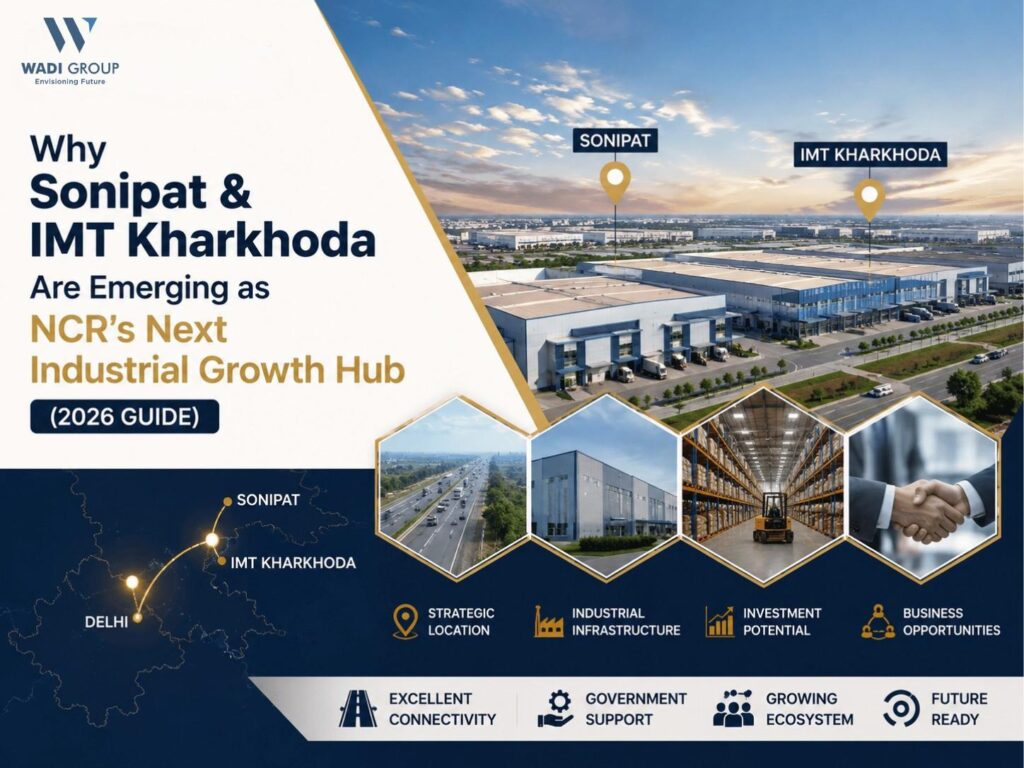
A decade ago, Sonipat was seen mainly as a pass-through district on NH-44 — somewhere between Delhi and Panipat, not a destination in its own right. That is changing. A combination of manufacturing investment, expressway and rail connectivity, and a formal industrial township at Kharkhoda is turning the belt into one of NCR’s more closely watched industrial corridors.
This shift isn’t being driven by one project or one announcement. It’s the layering of several things happening at once: a large automotive manufacturing base anchoring the region, a state-run industrial township with planned infrastructure, and multiple transit and road projects converging on the same stretch of land. For manufacturers, logistics operators, and long-horizon investors, that combination — infrastructure ahead of demand — is usually the signal worth paying attention to.
The Industrial Transformation of IMT Kharkhoda
IMT Kharkhoda (Industrial Model Township) is a planned industrial estate developed by HSIIDC (Haryana State Industrial and Infrastructure Development Corporation), spread across roughly 3,300 acres along the KMP Expressway. Plots within the township range from 450 sq. m to 16,000 sq. m, structured to accommodate everything from small ancillary units to large-scale manufacturing plants.
The township’s infrastructure plan includes dedicated power supply, water distribution, planned drainage and sewerage networks, internal road systems, and a Common Effluent Treatment Plant (CETP) — the basic utility layer that determines whether an industrial zone is actually usable versus one that exists only on paper.
The anchor investment: Maruti Suzuki’s manufacturing plant at Kharkhoda, reported at around ₹18,000 crore, is the single largest industrial investment in the belt and has been the primary reason IMT Kharkhoda gained national attention. It’s worth noting, though, that Maruti Suzuki is an anchor — not the only driver. The plant has continued to expand its footprint here: in 2025, it commissioned a 20 MWp solar power project at the facility, and more recently added a 1 MWh Battery Energy Storage System (BESS) to store surplus solar power generated during non-operational days, with an expected reduction of close to 54 tonnes of CO₂ emissions annually. That kind of ongoing capital investment — not just the original plant announcement — is a more reliable indicator of long-term industrial commitment to the region than a one-time headline.
This ecosystem effect is what typically pulls in ancillary and component manufacturers, logistics providers, and eventually residential and retail demand around a large anchor plant.
Why Sonipat Is Becoming an Investment Destination
Kharkhoda’s industrial growth doesn’t sit in isolation — it’s connected to a broader set of infrastructure upgrades across Sonipat district:
- NH-44: Direct arterial connectivity linking Sonipat to Delhi, Panipat, and further north to Chandigarh — the backbone for both passenger and freight movement.
- KMP Expressway: A roughly 135-km peripheral expressway around Delhi that links Kundli, Manesar, and Palwal, giving Kharkhoda-based industries direct access to multiple NCR industrial and logistics corridors without routing through Delhi’s core.
- UER-II (Urban Extension Road-II / NH-344M): Connects Sonipat to IGI Airport via Alipur, reportedly around 90% complete, cutting airport and freight access time meaningfully.
- Delhi Metro Yellow Line extension: In-principle approval has been granted (via Ministry of Housing and Urban Affairs) to extend the line from Samaypur Badli to Nathupur — a 26.5-km stretch adding 21 stations, expected to serve close to 50,000 daily commuters once operational, with Haryana funding 80% of the cost and the Centre covering the rest. It’s currently at the DPR and land-acquisition stage.
- Delhi–Sonipat–Panipat RRTS (Namo Bharat): A semi-high-speed rail corridor being developed by NCRTC that will connect Delhi to Panipat in around an hour, cutting straight through the Sonipat-Kundli belt.
- Sonipat Master Plan 2031: A ₹20,220 crore state initiative to develop the district into an urban center supporting up to 2.5 million residents, allocating over 7,000 hectares for integrated townships and 600+ hectares for commercial development.
None of these projects individually would justify the “growth corridor” label. Together — road, rail, and metro converging on one industrial base — they represent the kind of layered infrastructure build-out that historically preceded real estate and industrial demand growth in Gurugram and, more recently, along the Dwarka Expressway.
Key Growth Drivers
| Driver | What’s Happening |
|---|---|
| Manufacturing Expansion | Maruti Suzuki’s ongoing plant investment and sustainability upgrades (solar + BESS) signal long-term commitment, not a one-time entry |
| Logistics Infrastructure | KMP Expressway + UER-II give direct multi-directional freight access without routing through central Delhi |
| Expressways & Road Network | NH-44 and UER-II connect Sonipat to both the national highway grid and IGI Airport |
| Transit Corridors | Metro Yellow Line extension (in DPR stage) and RRTS (Namo Bharat) add passenger-side connectivity, supporting workforce mobility |
| Employment Generation | Large manufacturing hubs typically draw ancillary units and services, which is already reflected in rising residential plot demand in the surrounding belt |
| Supply Chain Ecosystem | HSIIDC’s planned utility infrastructure (power, water, CETP) reduces the operational risk that usually slows down industrial adoption in newer zones |
What Does This Mean for Businesses?
Should manufacturers consider Kharkhoda? For manufacturers evaluating NCR expansion, Kharkhoda offers direct highway access, HSIIDC-planned utility infrastructure, and proximity to an established automotive supply chain — factors that typically reduce both setup time and logistics cost versus more saturated zones like Gurugram or Manesar.
Should logistics companies expand here? The KMP Expressway and UER-II combination gives logistics operators multi-directional access — to Delhi, the airport, and the wider NCR ring — without the congestion typically associated with central Delhi routes. This is one of the more common reasons logistics and 3PL companies are scouting the belt.
Is this suitable for warehousing? Yes, for businesses prioritizing freight connectivity over city-center proximity. Warehousing demand tends to follow manufacturing clusters, and Kharkhoda’s anchor industrial base makes it a candidate for both captive and third-party warehousing.
Should investors monitor the market? Given that infrastructure (metro, RRTS, UER-II) is still in progress rather than complete, this is generally viewed as an earlier-stage opportunity relative to fully built-out NCR markets — which comes with both higher upside potential and the usual execution-timeline risk associated with infrastructure projects.
Industrial Plots vs. Residential Investment in the Sonipat-Kharkhoda Belt
| Parameter | Industrial Plots (IMT Kharkhoda) | Residential Plots (Sonipat) |
|---|---|---|
| Primary Use | Manufacturing, warehousing, ancillary units | Housing, end-use or rental |
| Typical Plot Size | 450 sq. m – 16,000 sq. m (HSIIDC township); 550–2,500 sq. yd. (private developer plots) | Varies widely; smaller residential parcels |
| Demand Driver | Anchor industries (e.g., Maruti Suzuki), logistics need, ancillary supply chain | Population growth, job creation, connectivity |
| Reported Price Trend (2020–2025) | Rising, tied to industrial absorption in the township | Land prices in the Kundli-Sonipat belt reported up to ~190% over the same period |
| Income Type | Business use or long-term lease income | Rental yield or resale appreciation |
| Liquidity | Lower short-term liquidity, longer hold typical for industrial use | Comparatively more liquid in an active resale market |
| Risk Profile | Tied to industrial demand and infrastructure completion timelines | Tied to population inflow and connectivity completion |
Neither category is inherently “better” — the right choice depends on whether the objective is business use/long-term industrial income versus residential appreciation or rental yield. Businesses planning manufacturing, warehousing, or supply-chain operations are the more direct fit for the industrial segment covered in this article.
Why Businesses Are Choosing IMT Kharkhoda
- Planned industrial township with HSIIDC oversight, rather than unregulated or informal industrial land
- Direct highway access via KMP Expressway, reducing dependency on congested city routes
- Established manufacturing ecosystem anchored by Maruti Suzuki, which lowers the risk profile for ancillary and component businesses
- Large, contiguous industrial land parcels, allowing for phased expansion without relocating
- Room for future expansion as UER-II, metro, and RRTS projects progress and improve last-mile access
Wadi Group Industrial Plots in Kharkhoda
Businesses looking to establish manufacturing units, warehouses, or industrial facilities can explore Wadi Group’s industrial plots in Kharkhoda, with sizes ranging from 550 to 2,500 sq. yd., positioned along the KMP Expressway within the broader IMT Kharkhoda corridor.
For a full breakdown of plot sizes, location advantages, and current pricing, see the project page below, or explore our related guides for a more granular, plot-level view (as opposed to the corridor-level view covered in this article):
- Kharkhoda, Haryana: Location, District & Complete Investment Guide
- Is Kharkhoda Good for Investment? Complete Kharkhoda Industrial Plot Guide 2026
- Advantages of Freehold Industrial Plots in Kharkhoda
- Why Kharkhoda Freehold Industrial Plots Are the Perfect Investment Opportunity in Delhi NCR
For warehousing-specific requirements:
- Warehouse Leasing Trends in India: What Businesses Need to Know
- Warehouse for Lease in India: Grade-A, RTM, and BTS Industrial Spaces
- Warehouse Leasing Services (RTM/BTS)
Frequently Asked Questions
Is Kharkhoda a good place for industrial investment?
Kharkhoda is developing as a planned industrial corridor with HSIIDC-backed infrastructure, direct expressway access, and an established manufacturing anchor in Maruti Suzuki. This combination is generally viewed favorably for manufacturing and logistics use, though — as with any industrial investment — outcomes depend on business fit, timeline, and individual due diligence.
Why is IMT Kharkhoda important for NCR’s industrial map?
IMT Kharkhoda represents one of the larger HSIIDC-developed industrial townships in the NCR periphery, offering plot sizes and utility infrastructure designed specifically for manufacturing and ancillary industries rather than mixed-use development.
What industries are expected to grow in Sonipat?
Given the automotive anchor at Kharkhoda, ancillary and component manufacturing, logistics and warehousing, and general and mechanical manufacturing are the categories most likely to see continued growth, alongside pharma and light manufacturing units already present in the township.
What is the benefit of investing near IMT Kharkhoda?
Proximity to an established industrial anchor typically reduces supply-chain distance for ancillary businesses, while the KMP Expressway location supports faster freight movement across the wider NCR.
Are industrial plots available near the manufacturing zone?
Yes — both HSIIDC-allotted plots within IMT Kharkhoda and privately developed plots (such as those offered by Wadi Group, sized 550–2,500 sq. yd.) are available along the KMP Expressway corridor near the manufacturing zone.
Why are logistics companies considering Kharkhoda?
The KMP Expressway and UER-II combination gives logistics operators access to Delhi, the airport, and the broader NCR ring without routing through congested central Delhi — a meaningful cost and time advantage for freight-heavy operations.
Sonipat and IMT Kharkhoda are evolving through a combination of industrial investment, infrastructure upgrades, and improving connectivity — not a single project or announcement. While every investment or expansion decision should be based on individual business goals, timelines, and due diligence, businesses planning manufacturing or logistics expansion may find it worthwhile to evaluate this corridor as its infrastructure continues to come online.